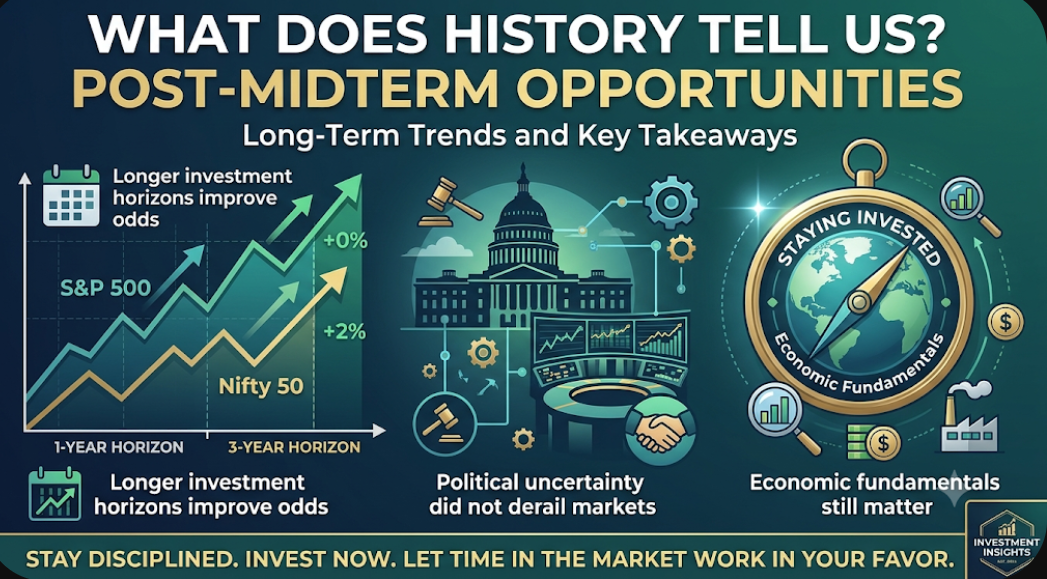
While US midterm elections often spark short-term volatility, historical data from the last seven cycles (2002–2026) shows that long-term equity investors benefit more from staying invested than waiting on the sidelines.
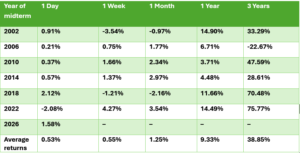
S&P 500: Post-Midterm Returns
Nifty 50: Post-Midterm Returns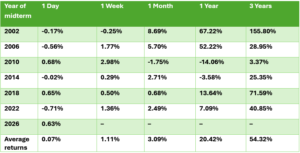
What Does History Tell Us?
- Longer investment horizons improved the odds:
The S&P 500 was positive in all six completed one-year periods (~9% average) and five of six three-year periods. The Nifty 50 delivered positive returns across all six three-year cycles, averaging ~54% (or ~33% excluding the 2002 outlier of 155.80%). - Political uncertainty did not derail markets:
Despite the opposition winning at least one chamber of Congress in six of the seven cycles, long-term returns stayed resilient. When the opposition won a single chamber (2010, 2014, 2018, and 2022), three-year returns averaged 55.61% for the S&P 500 and 35.29% for the Nifty 50. - Short-term reactions mattered less than staying invested:
The S&P 500 gained on the first trading day after six of seven elections (including 1.58% in 2026), while the Nifty 50 moved within a narrow -0.71% to 0.68% range. Waiting for political noise to settle rarely improves long-term investment outcomes. - Economic fundamentals still matter:
History is not a guarantee, as macro shocks can override election cycles, seen when the 2008 financial crisis dragged the 2006 S&P 500 cycle down 22.67% over three years. Today, headwinds like inflation, tariffs, energy costs, and Iran tensions remain critical variables.
The Takeaway: Post-midterm periods have historically favoured long-term equity investors. Despite near-term volatility, the data supports staying disciplined, investing now, and letting time in the market work in your favour rather than waiting on the sidelines.
Please note that the above should not be construed as an advice from us. Our company is in the business of distribution of suitable Financial Products to investors describing product specifications, material facts and the associated risk factors. We are acting as