
As of late Tuesday, GIFT Nifty indicated ~807 points lower (~3%), suggesting a weak opening for
Indian equities after the Holi holiday while market opened 2% lower on Wednesday. The US
markets also crashed with Dow, S&P 500 and Nasdaq each falling over 2%. Asian markets also fell
with Kospi crashing 7.8%
Geopolitical events typically trigger sharp but temporary volatility. History provides useful
perspective
What Analysts say
- Top research houses say that a 10% increase in oil prices can increase current account deficit
by 0.4% while the inflation pass through could be limited - Impact of closure of Strait of Hormuz can increase freight cost by 3%-5% though volumes are
unlikely to be affected based on past experiences - Also, the current assessment is that US doesn’t want a protracted war and is likely to
terminate it in a matter of 4-6 weeks.
Market Reaction to Major Geopolitical Conflicts
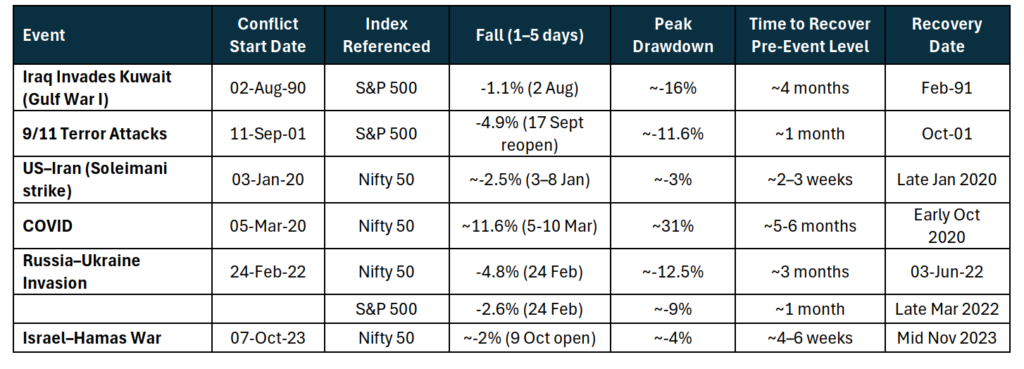
Historical pattern:
- Geopolitical escalations have typically triggered an immediate equity correction in the
range of 2–10%, accompanied by a spike in volatility - Once the extent of the conflict becomes clearer and systemic risks are reassessed, markets
have generally stabilised and recovered over the following 3-4 months. - Historical data across multiple conflicts shows that equity markets tend to discount
uncertainty rapidly, with medium-term performance ultimately driven more by earnings,
liquidity, and macro fundamentals than by the conflict itself - Such corrections have historically created attractive entry points for disciplined investors
with a long-term horizon
Please note that the above should not be construed as an advice from us. Our company is in the business of distribution of suitable Financial Products to investors describing product specifications, material facts and the associated risk factors. We are acting as a Distributor for these products and facilitating transactions