
As geopolitical tensions in the Middle East escalated in last one-month, crude markets have entered another volatile phase. Escalation involving the U.S., Israel, and Iran, including attacks affecting production and transport infrastructure, has disrupted supplies and pushed Brent crude above $110 per barrel.
India remains highly exposed to hikes in oil prices. The country meets nearly 85% of its crude needs through imports, and around 50% of crude, 60% of LNG, and over 80% of LPG imports transit through the Strait of Hormuz.
Short Term Macroeconomic Impact on India:
- Every $1 rise in crude adds roughly $1.5-2 billion to India’s annual import bill, and a $10 increase can widen the current account deficit by ~0.35-0.5% of GDP
- A sustained $10 rise in oil can add 30-40 basis points to CPI inflation, as higher fuel and logistics costs pass through the economy.
- Higher oil prices can pressure the rupee: the Indian rupee has recently weakened to around ~₹95 per US dollar, hitting record lows
Rising crude prices exert immediate pressure on India’s macroeconomic stability through higher import bills, inflation, and currency weakness. These effects typically translate into increased volatility in financial markets in the short term.
However, historical evidence suggests that while elevated oil prices moderate equity returns, they do not necessarily lead to sustained market declines. Instead, the Indian stock market has shown resilience, with markets stabilizing and recovering as economic adjustments take place.
How Does Nifty React when Crude Rises?
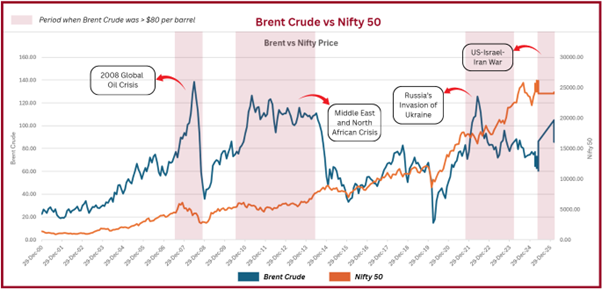
Oil spikes over last 26 years and NIFTY Upward trend despite cycles
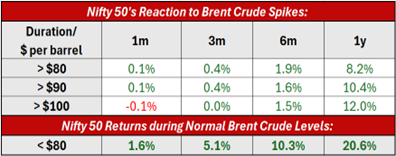
NIFTY 50’s 1m, 3m, 6m, 1y rolling period returns during the past 26 years
- When Brent crude stays below $80, Nifty has historically delivered stronger returns, with 1-year gains averaging around 20%.
- Above $80, returns moderate to 8-12%, reflecting more muted market performance.
- While higher crude does not automatically trigger market declines, the data shows subdued performance in the Nifty during high oil regimes, especially compared to phases of stable, low crude.
What Can We Expect Now?
Oil prices in 2026 remain uncertain. Short-term supply disruptions can keep prices elevated, but broader supply-demand adjustments may stabilize markets over time. Oil remains an important macro trigger, yet Indian equities have historically shown resilience across elevated crude phases.
In such an environment, investors should remain composed, anchor decisions to long-term fundamentals, and avoid reacting to temporary geopolitical volatility.
(Sources: Axis Securities, Ministry of Petroleum & Natural Gas, Kpler, RBI)
Subscribe on LinkedInPlease note that the above should not be construed as an advice from us. Our company is in the business of distribution of suitable Financial Products to investors describing product specifications, material facts and the associated risk factors. We are acting as a Distributor for these products and facilitating transactions