
How Does Nifty Perform After Sharp Rupee Depreciation?
The Indian rupee has witnessed several sharp depreciation episodes over the past two decades, driven by events such as the Global Financial Crisis, the Eurozone debt crisis, the 2013 Taper Tantrum and the recent global monetary tightening cycle. While a weaker rupee is generally viewed as a negative for the economy and investor sentiment, does it necessarily translate into weaker equity market returns?
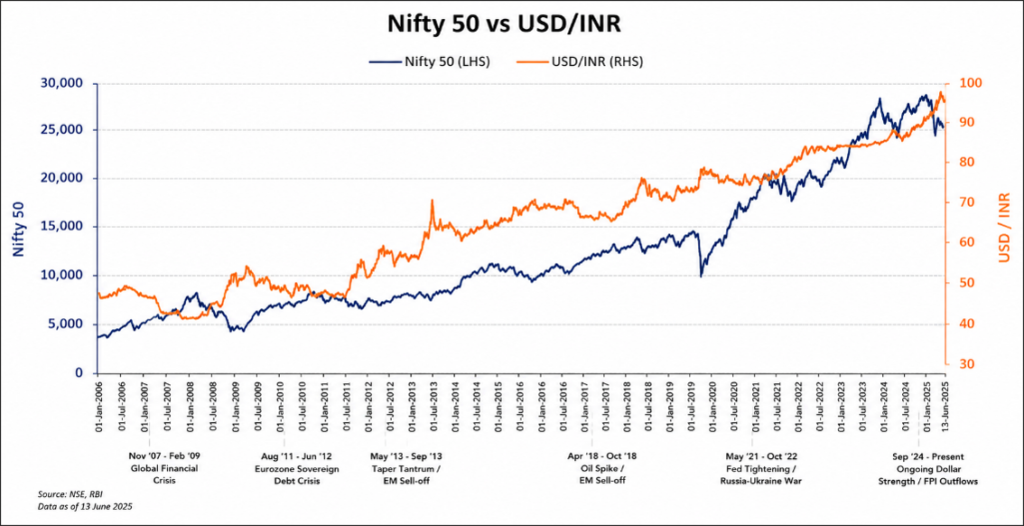
To explore this, we analyzed every major episode since 2007 where the rupee depreciated by more than 10% against the US dollar and measured the Nifty 50’s performance after the depreciation cycle ended.
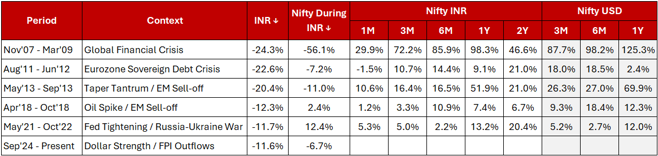
Table: Nifty 50 Forward Returns After Major INR Depreciation Episodes
Key Observations
- Markets have historically recovered quickly. Across the five completed episodes, Nifty returned 9.1% over one month and 21.5% over three months on average, with all five episodes positive by the three-month mark.
- Medium-term performance remained favorable. Average returns rose to 26.0% over six months and 36.0% over one year, as external pressures eased and sentiment improved.
- Long-term outcomes remained compelling. The average two-year annualized return was 23.1%. Despite differing triggers: from the GFC to tighter US Fed policy, periods of sharp rupee weakness have historically provided attractive long-term entry points for Indian equities
- Foreign investors benefited from both equity and currency gains. While the table primarily presents Nifty returns in INR terms, USD-denominated returns were generally higher over the 6-12 month period, indicating that the rupee often stabilized or appreciated after sharp depreciation. This provided an additional return tailwind for USD-based investors.
What does this mean?
Sharp rupee depreciation has historically marked periods of elevated uncertainty rather than lasting weakness in Indian equities. Across all five completed episodes, Nifty generated positive returns over the subsequent three months, one year and two years, suggesting that periods of substantial currency weakness have historically presented significant attractive long-term buying opportunities
Data indicates periods of sharp rupee weakness provide significant attractive long-term entry points for Indian equities.
Subscribe on LinkedInPlease note that the above should not be construed as an advice from us. Our company is in the business of distribution of suitable Financial Products to investors describing product specifications, material facts and the associated risk factors. We are acting as a Distributor for these products and facilitating transactions